Getting married in Old Montréal
A civil ceremony at the courthouse or a wedding at Notre-Dame, photos on the cobblestones and by the Old Port, the seasons, guests who travel and a wedding in two languages.
Picture walking out of your ceremony onto rue Notre-Dame. The bells of the basilica are ringing, the cobblestones of rue Saint-Paul are a block away, and the river is at the bottom of the hill. Your guests follow you on foot, and nobody needs a car until the end of the night.
Old Montréal is where the city began, and it still feels like a small town inside a big one. Here is how to plan a wedding there, with a little of its history where it helps.
Where to say yes
Old Montréal is small, so the ceremony, the photos and the dinner can all be a short walk apart.
The city started on this ground. In May 1642, Paul de Chomedey de Maisonneuve and Jeanne Mance landed with a small group of settlers and founded Ville-Marie, on the point where the Pointe-à-Callière museum stands today. By the 1960s, the old quarter had been left to decline, and in 1964 Québec declared it a historic district to protect it. Its stone warehouses and narrow streets are why it photographs so well.
A civil ceremony at the courthouse. The Palais de justice de Montréal is in Old Montréal itself, at 1 rue Notre-Dame Est, a few minutes’ walk from the basilica. In Québec, a clerk of the Superior Court can marry you there. A notary, a mayor, a city or borough councillor, or a municipal employee can also celebrate a civil marriage, and a relative or friend can be designated by the Directeur de l’état civil to do it. Courthouse ceremonies are not held on Sundays or public holidays, and the days and hours vary by district, so ask the courthouse early.
Whatever ceremony you choose, a notice of your marriage is published on the Directeur de l’état civil’s website for 20 days before the wedding. Plan it with your celebrant well ahead, especially if you live outside Québec.
Notre-Dame Basilica. For a Catholic wedding, the basilica marries couples either in the church itself or in the smaller Notre-Dame-du-Sacré-Cœur chapel. Weddings are usually on Saturdays from April to November, never on Sundays. The parish asks couples from the Montréal area to get in touch at least six months ahead, and couples from farther away at least eight; there is marriage preparation and a rehearsal the week before.
The church you will walk into was built from 1824 to 1829 by James O’Donnell, a Protestant architect from New York. He became a Catholic before he died in 1830 and is buried in its crypt. The chapel behind it was badly damaged by fire in 1978 and reopened in 1982, with a modern vault over its rebuilt walls and a large bronze altarpiece.
Restaurants, hotels and old warehouses. Many of Old Montréal’s restaurants and hotels have private rooms for a dinner or a reception, and some of its warehouses have become event spaces. Ask each one for its capacity, its prices and whether your celebrant can marry you there; we have no tie to any of them.
Photos in the old streets
The cobblestones. Rue Saint-Paul is often called the oldest street in the city, and it looks the part: stone fronts, iron lamps and cobblestones. Go early in the morning, before the shops open, when you have it nearly to yourselves. Bring flat shoes for the walk and keep the heels for the dinner.
Place Jacques-Cartier. The square slopes down from rue Notre-Dame towards the river. It was laid out as a market after a fire in 1803, and it took Jacques Cartier’s name in 1847. At the top stands Nelson’s Column, put up in 1809, decades before the one in London’s Trafalgar Square.
The Bonsecours dome. Marché Bonsecours, the long stone building with the dome near the water, was finished in 1847 and served as Montréal’s city hall from 1852 to 1878. Its facade makes a wide, simple background, and next to it is the Notre-Dame-de-Bon-Secours chapel, known as the sailors’ church for the model ships hanging inside.
The Old Port. Down at the water, the quays give you space, sky and the river. At the east end, the Clock Tower was built from 1919 to 1922 as a memorial to sailors killed in the First World War. Late in the day, the stone of the old quarter turns warm behind you.
Notre-Dame from Place d’Armes. The square in front of the basilica gives you its two towers at full height; stand back towards the far side of the square to fit them in.
Planning around the season
Summer is warm and lively, with long evenings and terraces on every street. It is also when Old Montréal is busiest, festivals fill the city and hotels book up first.
Fall is the season of our scene, and a good one. The maples on the mountain and in the squares turn red and orange in October, the evenings are cool and the crowds thin out. Bring a wrap for photos after sunset.
Winter is cold and snowy, with short days, but the old quarter is beautiful under snow and much quieter. Keep photos outside short, and remember that the basilica only marries couples who are not parishioners from April to November.
Whatever the season, give your guests time to plan: when to send your save the dates has a timeline.
Guests who travel
Montréal–Trudeau airport (YUL) is linked to downtown by the 747 bus, which runs day and night all year. From downtown, the metro takes them to Place-d’Armes, Champ-de-Mars or Square-Victoria–OACI, the three stations that serve Old Montréal. VIA Rail trains, from Québec City among others, arrive at Central Station, downtown, a short taxi or metro ride away.
Old Montréal has hotels of every size, from small inns in old stone houses to large hotels along its edges. As soon as you have a block of rooms, put it on your save the date so guests book while there are rooms left.
A wedding in two languages
Montréal weddings often bring together families who speak French, English or both, and many who speak a third language at home. In Québec, the celebrant marries you in French or in English, as you choose; if one of you does not understand the language, the celebrant will ask you to bring an interpreter.
Your save the date can follow the same rule. Send each family the version in the language it reads best, in up to 30 languages: see one save the date, in up to 30 languages. And if you write in both English and French, read English and French, written properly on why each one deserves its own wording.
Our Montréal save the date
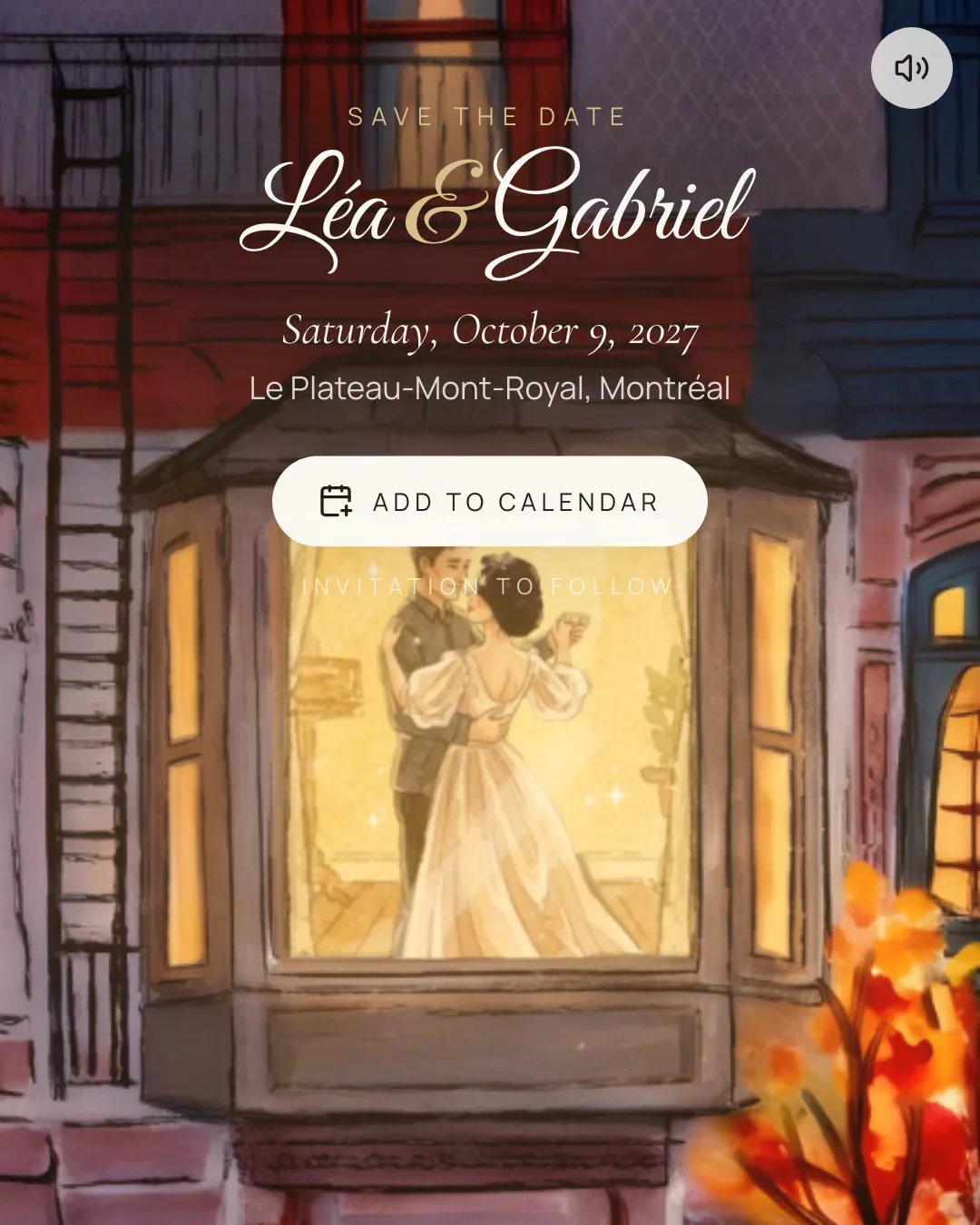
Our Montréal save the date is not set in Old Montréal itself, but a little farther up the hill, on an autumn evening in a street of greystones with mansard roofs, red maples and pumpkins on the steps. Your guest breaks the wax seal on an envelope, and a card slides out and fills the screen.
A woman rides past on her bicycle, a basket of sunflowers at the front. As she goes by, a bay window lights up, and behind it a bride and groom are dancing. The rest of the house lights up, the view closes in on the couple, and your names, date and place appear above them, with a button to add the day to the calendar.
It is painted in watercolour, and you can play it today on the templates page. You can also choose it when you create your own save the date, with your names, your date and your place, Old Montréal included, and start for free.
Sources
- Birthplace of Montréal and Maisonneuve, Montréal’s first builder, Pointe-à-Callière, for the founding of Ville-Marie in 1642.
- Plan de protection et de mise en valeur du Vieux-Montréal, City of Montréal (in French), for the 1964 historic district.
- History and Marriage, Notre-Dame Basilica of Montréal, for the church, the chapel and how to marry there.
- Palais de justice (Montreal), Wikipedia, and Montréal judicial district, Superior Court of Québec, for the courthouse.
- Government of Québec, Célébrants compétents and Moment du mariage et langue de la cérémonie, and Directeur de l’état civil, Publication d’un avis de mariage (in French), for civil ceremonies, the notice and the language of the ceremony.
- La colonne Nelson, Mémoires des Montréalais (in French), and Place Jacques-Cartier, Wikipedia, for the square and the column.
- The Marché Bonsecours, The Canadian Encyclopedia, for the market and city hall.
- Old Montreal, Wikipedia, for the metro stations and the 1964 historic district.
- Saint-Paul Street, Wikipedia, for the street.
- The Clock Tower celebrates its centennial, Old Port of Montréal, for the Clock Tower.
- 747 YUL Aéroport Montréal-Trudeau/Centre-ville, Tourisme Montréal, for the airport bus, and VIA Rail, Montréal Central Station and Montréal–Québec (in French), for the trains.