One save the date, in up to 30 languages
Pick the languages your guests read, from English and French to Punjabi, Persian or Tagalog, and get one link per language to share.
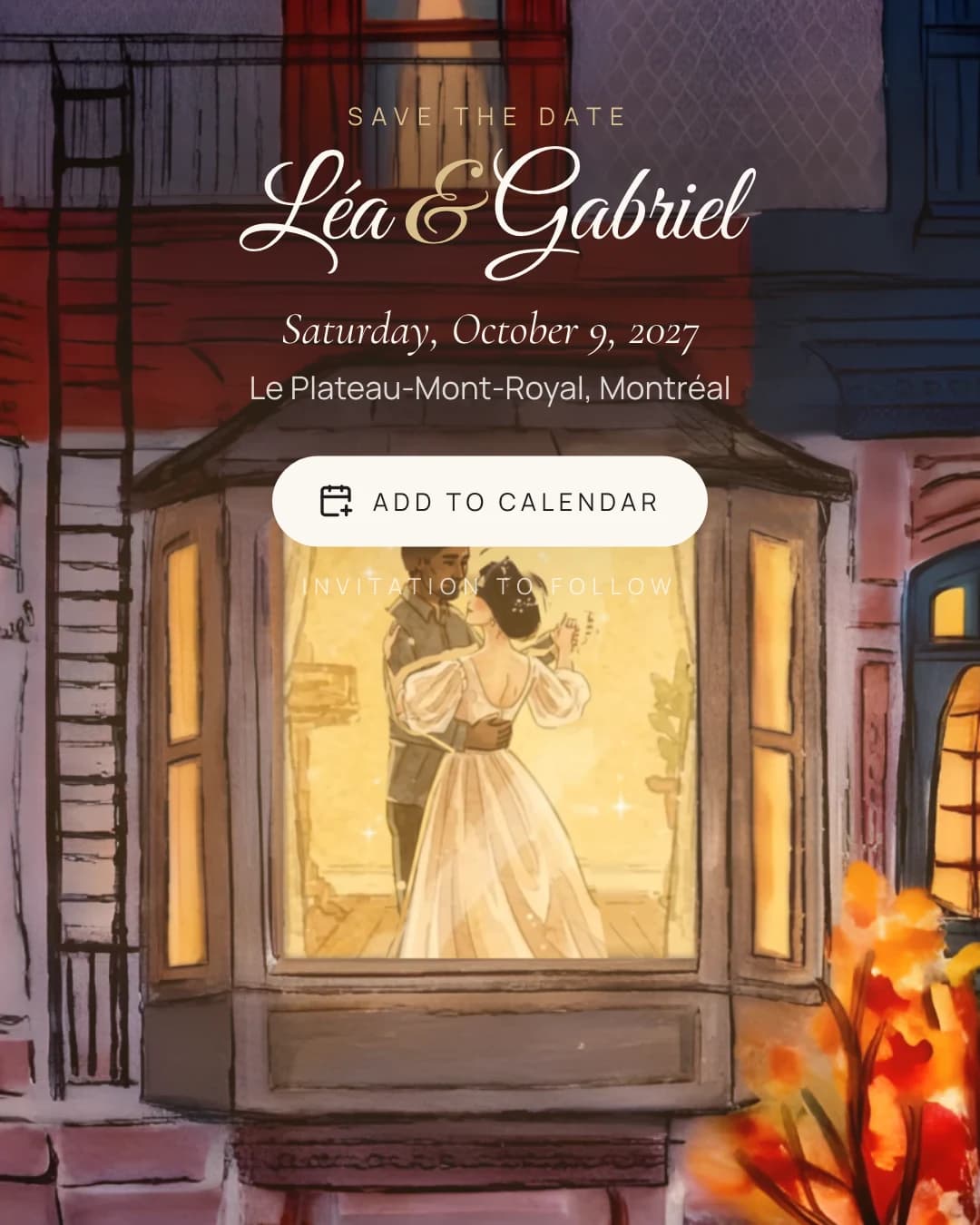
A Canadian wedding rarely has one language. The couple may speak English to each other and French at work. One grandmother reads Punjabi, an uncle reads Portuguese, the cousins from Tehran read Persian.
Until now, a save the date on Zendegi.Studio spoke English and Canadian French. It now speaks up to 30 languages, and you choose which ones.
How it works
After you choose your scene, we ask one question: which languages will your guests read it in?
You start with your own language already picked. Type a few letters in "Add a language" to find the next one; "esp" finds Español, "fa" finds فارسی. Every language is written in itself, so the person who reads it can recognise it, even if you cannot.
Before anything is created, we show you a short summary: your scene, and the languages you picked. Then "Create my links" gives you one link per language.
One link per language
Each language has its own short link, like zendegi.io/h7red6jr.
Whoever opens it sees the save the date in that language, whatever language their phone is set to.
That matters more than it sounds. Many guests read one language and keep their phone in another. An aunt who reads Vietnamese may have an English phone because that is how it came out of the box. With one link per language, you decide what each household reads, not their phone settings.
The link is random, not your names, so nobody can guess it. It is not listed in search engines. And if you add or remove a language later, the links you already sent keep working.
What changes in each language
Everything your guest reads on the scene:
- the hint that tells them to tap to open it;
- "Save the date" and "Invitation to follow";
- your date, written the way that language writes dates;
- the "Add to calendar" button and the calendar sheet behind it.
Arabic, Persian, Hebrew and Urdu read right to left, and so does the scene.
Your names and your place stay exactly as you typed them. If you want them in another script too, write them that way in your details.
The preview that shows up when you paste the link in a chat follows the link’s language as well: the closed envelope, curtains or maple leaves, with "Save the date", your names and your date. For a few scripts our preview renderer cannot draw yet, that preview is in English; the save the date itself is not.
The 30 languages
English, Français, Español, Português, Italiano, Deutsch, Nederlands, Polski, Română, Ελληνικά, Svenska, Türkçe, Русский, Українська, العربية, فارسی, עברית, اردو, हिन्दी, বাংলা, ਪੰਜਾਬੀ, 中文, 日本語, 한국어, Tiếng Việt, ไทย, Bahasa Indonesia, Tagalog, Kiswahili and Kreyòl ayisyen.
We chose them for the families who get married in Canada, and for the relatives who fly in to join them. If yours is missing, tell us.
Free, in every language
Languages are not an extra. The free save the date includes every language you pick, with one link each, to share yourself by email, text or in a family chat. Premium, at $125 CAD per event, adds the RSVP and a personal link for every household, sent for you. You can read more in what is free and what Premium adds.
A few tips
- Ask before you guess. A parent often knows which language each side of the family reads best.
- Send one language per household. If a household reads two, send the one the eldest reads; the younger ones usually manage either.
- Open each link yourself. You may not read Korean, but you will see the scene play and the date appear. See try your save the date on yourself first.
The point of a save the date is that everyone you love knows the day. Reading it in their own language is part of feeling invited.